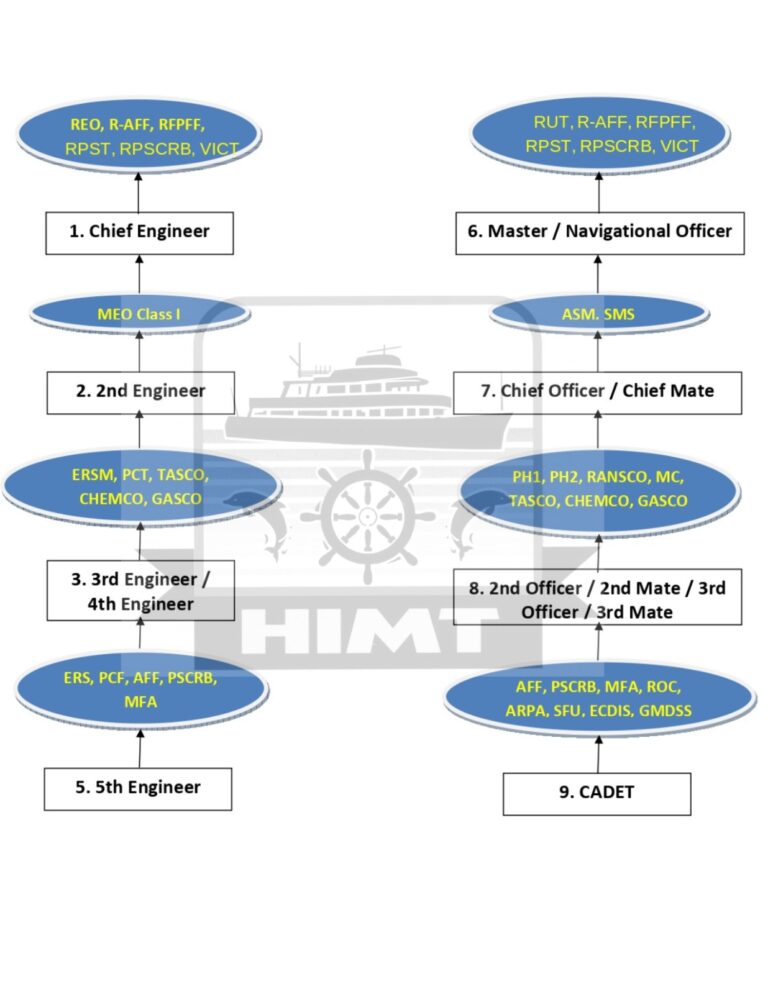
The position of Chief Engineer is the highest rank in a ship’s engine department. It requires technical expertise, leadership ability, and extensive sea experience. This article outlines the step-by-step process for becoming a Chief Engineer in the Merchant Navy, from education to certification.
Role of a Chief Engineer
A Chief Engineer is responsible for the operation, maintenance, and management of all machinery and technical systems on board a ship. This includes propulsion engines, generators, pumps, electrical systems, and auxiliary equipment. The Chief Engineer ensures that all machinery operates efficiently and safely while supervising the entire engine department.
Educational Qualification
To begin a career in the engine department, a marine engineering background is essential. The following are the primary entry routes:
a. After 10+2 (Science Stream)
Enroll in a B.Tech in Marine Engineering (4 years).
Eligibility: Minimum 60% aggregate in Physics, Chemistry, and Mathematics (PCM) and at least 50% in English.
b. After Diploma in Engineering
Enroll in a B.Tech in Marine Engineering Lateral Entry (3 years).
Eligibility: Diploma in Mechanical, Marine, Electrical, or Shipbuilding Engineering.
c. After B.E./B.Tech in Mechanical Engineering
Pursue a Graduate Marine Engineering (GME) course (1 year).
This program is intended for mechanical engineering graduates seeking a transition to the maritime field.
Onboard Training
After completing the pre-sea program, candidates must undergo shipboard training as a Trainee Marine Engineer (TME) or Junior Engineer.
Duration: 6 to 12 months (depending on the company and vessel).
Objective: To gain practical experience under senior engineers and become familiar with shipboard machinery, maintenance routines, and safety practices.
4. MEO Class IV Certificate of Competency (CoC)
After completing the required onboard training, candidates must appear for the MEO Class IV CoC examination conducted by the Directorate General of Shipping (DGS), Government of India.
This certification allows the candidate to serve as a Fourth Engineer on merchant vessels and clear the MMD exam.
Post-Sea Courses Required for MEO Class IV:
Mandatory STCW Courses:
Basic Safety Training (BST) which includes
Elementary First Aid (EFA)
Security Training for Seafarers with Designated Security Duties (STSDSD)
Advanced / Operational Level Courses:
Advanced Fire Fighting (AFF)
After completing these courses and the required onboard training, candidates can appear for the MEO Class IV examination and begin their career as 4th Engineers.
5. MEO Class II Certificate of Competency (CoC)
After serving as a 4th Engineer and gaining the required sea time, candidates can apply for the MEO Class II CoC examination, which allows them to serve as a Second Engineer and clear the MMD exam.
Post-Sea Courses Required for MEO Class II:
High Voltage Training (Operational or Management Level, depending on vessel type)
Advanced Fire Fighting (Refresher, if required)
Proficiency in Survival Craft and Rescue Boats (Refresher, if required)
Medical First Aid (Refresher, if required)
Tanker Familiarization (OCTCO) (mandatory for tanker vessels)
Completion of these courses and sea service requirements makes the candidate eligible for promotion to 2nd Engineer.
6. MEO Class I Certificate of Competency (CoC)
To reach the rank of Chief Engineer, candidates must obtain the MEO Class I CoC, which represents the highest level of certification in the engine department, and clear the MMD exam.
Post-Sea Courses Required for MEO Class I:
Advanced Fire Fighting (Refresher, if required)
Proficiency in Survival Craft and Rescue Boats (Refresher, if required)
Additional Recommended Courses:
Ship Security Officer (SSO) Course
Risk Assessment and Incident Investigation Course
These advanced-level courses prepare engineers for management responsibilities, crisis management, and compliance with international maritime standards.
7. Career Progression Path
|
Rank |
Certification Required |
Post-Sea Courses |
|
4th Engineer / 3rd Engineer |
MEO Class IV CoC – MMD |
BST (PST, FPFF, EFA, PSSR), AFF, PSCRB, MFA, ERS (Operational), STSDSD |
|
2nd Engineer |
MEO Class II CoC – MMD |
ERSM (Management), High Voltage, AFF & PSCRB Refresher, Shipboard Safety Officer, Tanker Familiarization (OCTCO) |
|
Chief Engineer |
MEO Class I CoC – MMD |
ERSM (Management), High Voltage (Management), Leadership & Teamwork, Ship Management, SSO, Environmental & Energy Courses |
Conclusion
Becoming a Chief Engineer in the Merchant Navy is a progressive process that combines academic qualifications, practical training, and professional certification. It demands consistent effort, discipline, and commitment to technical excellence. With experience and the necessary certificates of competency, marine engineers can advance to the position of Chief Engineer and take full responsibility for the ship’s engine department.